
Product Index: Apparel & Accessories

 — 
May 30, 2024

The APR MAG Product Index allows for more meaningful conversations around product by setting the language standards around key, objective characteristics. It pushes reviews beyond the solely subjective experience into the nuances of expertise—facilitating discussion around what makes a product unique and useful.

By indexing your own apparel or accessories and comparing them with the APR MAG Product Index you will better understand which qualities are important for you. The index guides you in communicating your preferences by referring to objective characteristics and therefore serves as a tool for enabling better-informed consumers.

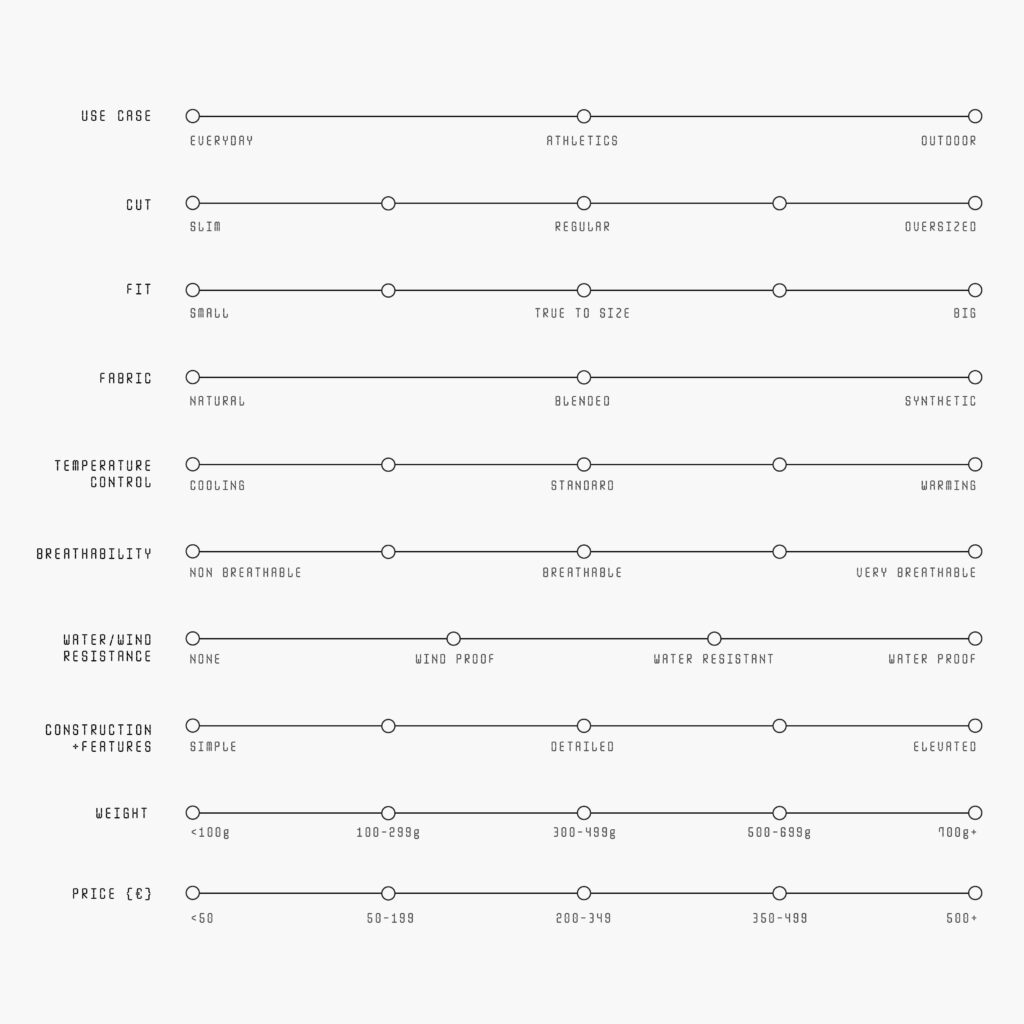
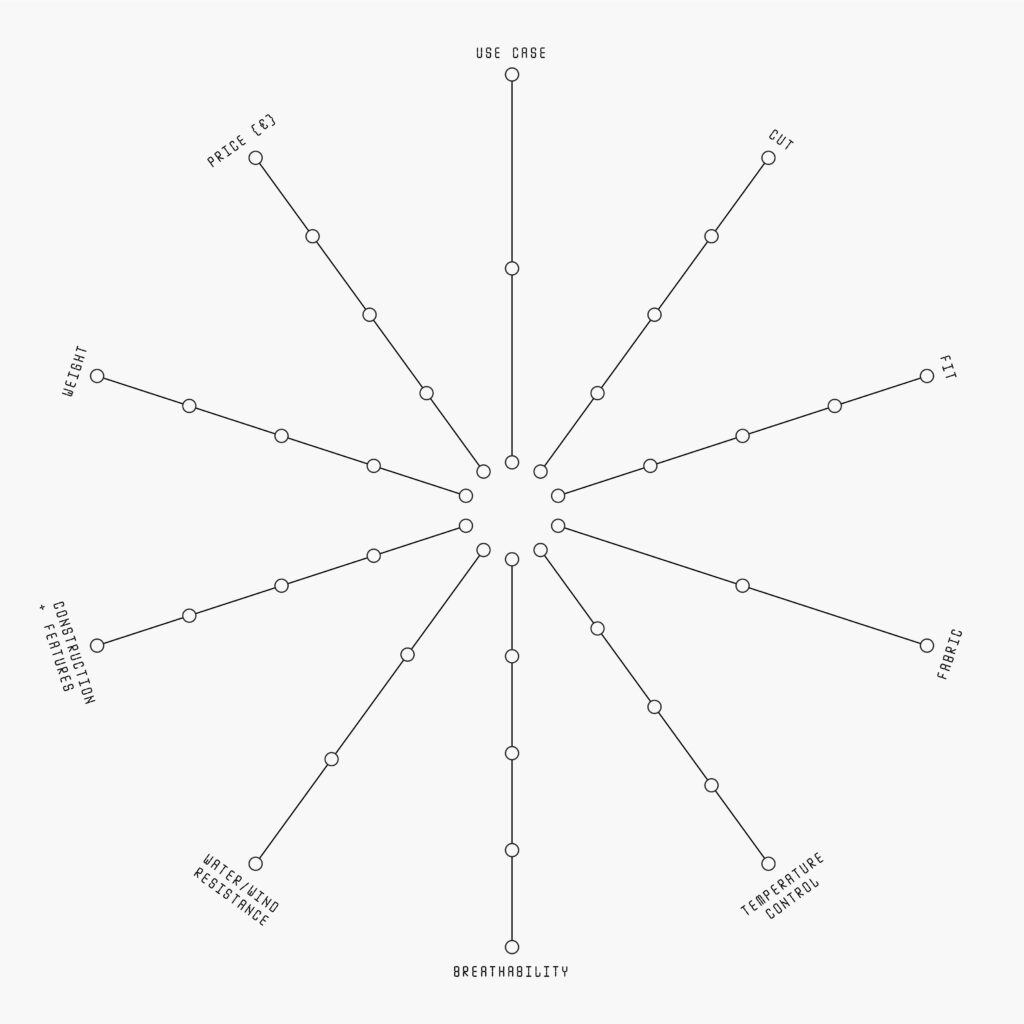
We’ve broken down this Apparel Product Index into 10 key characteristics: Use Case, Cut, Fit, Fabric, Temperature Control, Breathability, Water/Wind Resistance, Construction + Features, Weight, and Price.
Use Case:
The intended use of a product broken up into three categories—Everyday, Athletics, and Outdoor. Everyday: intended for everyday, casual, lifestyle wear. Athletics: Performance product for working out, competing, and other intense physical activities. Outdoor: intended for use in nature, excursions, camping, etc.

Please be aware that, especially with Use Case, categories may seamlessly blend into one another.

Cut:
The style and silhouette of a product ranging from slim to oversized. 

Fit:
The accuracy of a products size chart and grading.

Fabric:
The type of material used broken up into 3 general categories of natural, blended, and synthetic. Blended refers to a hybrid of natural and synthetic fibers, such as for example a cotton-polyester blend.

Temperature Control:
The products ability to remove or retain heat rated on a scale from Cooling, Standard, to Warming.

Breathability:
The overall ability of the product to allow for airflow between it’s layers rated on a scale from Non-Breathable to Very Breathable.

Water/Wind Resistance:
The products performance in various weather conditions. Broken up into four categories: No Weather Resistance, Wind Proof, Water Resistant, and Water Proof. 

Weight:
The products weight per square meter of fabric. Ranging on a scale from > 100g to 700g+

Price:
Ranging from <50€ to >500€.


EXPLORE PRODUCT INDEX

Use Case
Intended use case by the brand, broken down into three categories: Trail, Road, and Race
Cushion
The softness of the shoe’s sole, determined by it’s use of foam. More cushioning increases the level of impact protection while running with minimal cushioning comes closer to a natural running experience (e.g. barefoot). Since there are different types of foams, the equation of “the more foam the softer” does not always work. It is crucial to consider which type of foam it is. Ranging from Hard to Super Soft.
Padding
The amount of padding in the upper. Ranging from No Padding to Very Padded.
Flexibility
The ability to flex when compressed from heel to toe and when twisted. Flexibility and Stability are highly interdependent. As a rule of thumb you can say: the more flexible, the less stable. Ranging from Stiff to Flexible.
Stability
The amount of support provided to the natural rolling movement of the foot. The main factors influencing stability are the sole’s construction and its width. The construction of the upper and the type of lacing can also add to stability. Special Lacing is not considered within this category. Ranging from Free to Supportive.
Traction
The ability of the shoe to maintain stable contact with the ground, mostly determined by the construction of the sole. Added components from external brands such as Vibram or Megagrip can highly influence traction. Ranging from Slick to Very Grippy.
Breathability
The overall mesh density of the upper. Ranging from closed to open
Propulsion
The amount of forward pushing energy return determined by the construction of the sole. Various sole types can add a propulsive effect to the sole such as a Rocker construction or a carbon plate in combination with an energy-returning foam. Ranging from Relaxed to Aggressive.
Drop
The difference in height from heel to forefoot. Ranging from 0mm to 12mm.
Stack Height
The amount of forward pushing energy return determined by the construction of the sole. Various sole types can add a propulsive effect to the sole such as a Rocker construction or a carbon plate in combination with an energy-returning foam. Ranging from Relaxed to Aggressive.
Width
The shoes overall width at its base. This category only refers to the upper to provide information for the overall fit. Ranging from Narrow to Wide.
Width
The overall weight of the shoe. For comparison, we always use the weight of size US 9 for men. Ranging from Ultra Light to Heavy—Ultra Light (<240g), Lightweight (240–280g), Medium (280–320g), Heavy:  (>320g).

multi-faceted platform within the athletic and outdoor culture.

© 2025 by APR MAG

Fischer & Santiago GbR
Auguststraße 47a
10119 Berlin
Germany